Monday, December 25, 2017

Friday, December 22, 2017
Everything You Need to Know About Starting a Podcast in 2018
I’ve become a morning walking companion to people I may never meet.
How is this possible? They take me along in their earbuds as they stream my podcast, Build a Better Agency
It’s a wonderful sign of things to come for marketers willing to venture into the podcasting universe.
Once a fringe platform, podcasts are now surprisingly mainstream. According to Nielsen, six out of 10 people understand what they are, and 112 million Americans -- 40 percent of the nation’s population -- have listened to at least one. Though podcast listeners lean male, it isn’t by much: 56 percent are men, while 44 percent are women.
Marketing professionals must not only be aware of these statistics, but they must also leverage them in their own campaigns. When 67 million men and women are monthly podcast consumers, it’s a niche that deserves serious contemplation. Add to that fact the amazing statistic that 63 percent of podcast listeners made a purchase based on something the host recommended, and you have yourself a veritable gold mine.
Of course, you have to crawl, then walk, then break into a steady trot to glean the benefits.
A no-nonsense primer from a podcast experimenter.
In my case, I’d written blog posts, conducted webinars, and published articles in places like Forbes and Fast Company for some time. These content producers worked, but I felt a different portal would help connect with more agencies and leaders in an accessible, easy to find, on-demand format.
As a longtime podcast listener myself, I recognized that the podcasting platform was the next logical step for me -- especially if I wanted to reach a narrow audience of mid-sized agency owners and leaders as an authority in my field for more than 23 years. And as a long-time professional, I hired Predictive ROI, an Agency Management Institute agency, to produce the podcast so I wouldn’t make as many rookie technical mistakes.
Still, opening yourself up to podcasting is a little like breaking the lid on Pandora’s box. Until you do it, you have no idea what to expect. Still, that doesn’t mean you can’t head off issues before you go live.
Expect a certain amount of learning as you go, but be ready to explore the technology before fully launching your podcast. You wouldn’t open a bakery with your very first pie, so don’t hit “publish” until you get the lay of the land and make a plan. (Being a podcast guest prior to launching your own is a smart idea, too.)
Podcasting in the beginner’s circle.
Even if you’ve never been in front of a mic before, you can map out the first phase of a solid podcast schedule. From there, you’ll be able to branch out.
1. Create a checklist to keep yourself on task.
I asked myself tons of questions repeatedly before committing to podcasting. They included everything from the niche audience I wanted to reach to whether being the host of a podcast was a short-term fad or a long-term interest. I also considered what podcast style I preferred to offer the public, including a show prep and publishing schedule.
Obviously, your checklist will be individualized, but be sure it includes a section on technical elements. Setting up audio, iTunes, accounts, and interviews can be tricky if you haven’t done your homework.
2. Set up your basic show format.
Every interviewer prefers to run his or her podcast in a particular way. Many podcasters ask guests the same questions, but as a listener, I find that gets stale in a hurry. Sure, it’s less prep work, but it makes the host look lazy. I preferred interviewing subject matter experts but wanted to occasionally keep the door open to produce a solocast. My compromise was a 4–1 ratio of interviews to solocasts.
I was reasonably confident that I could have a few questions on hand and then launch into a conversation on the fly from there. A big risk? Maybe. But I believed I could pull off a 45-minute to 60-minute conversation without a safety net.
3. Leverage the heck out of your network.
The first 10 episodes set the tone for any podcast launch, so make sure you line up high-profile, interesting, engaging guests who won’t be turned off if you have very few -- or no -- listeners. My friends came through in a big way for me, offering me rock stars from day one. Not only did they help publicize the podcast, but they also generously allowed me to ride on their social media coattails.
4. Track your downloads.
Rob Walch was one of my recent podcast guests who offered an important consideration for any podcasters: You have to stay on top of your downloads. Rob’s suggestion is to hit at least 500 downloads an episode to feel sure you’ve broken the cycle of only having people in your inner circle tune in.
What’s a reasonable download number for your, quote, “success”? Only you can determine this, but it helps to keep a steady eye on the numbers. Starting to see a downward trend in listenership? Go back to square one and ask those tough questions again so you can pivot before your podcast loses traction.
5. Produce great content consistently.
Does everyone have a bad episode once in a while? Sure. And if you’ve planned in advance and have great content in the bag, you can simply not release it in lieu of a better one. Before you release your podcasts publicly, try to have several on hand. That way, you get the relief of a buffer zone.
Don’t try to start too quickly. You can always ramp up your delivery later. With my travel schedule that sees me on no fewer than 200 planes a year, I decided to get 10 episodes in before I proved to myself I could sustain the effort. August and September 2015 were a flurry of set-up and recordings, and we opened our podcast doors -- virtually -- in October 2015. Since then, we’ve published a new episode weekly without fail.
6. Prepare to become a podcast promoter.
Your target personas won’t find your podcast without a little help, so promote it like your life depends on it. I utilized our company’s email list, my personal social channels, and myriad other platforms. In addition, I requested that each guest promote his or her episode.
We were fortunate to get on iTunes New and Noteworthy, landing us in the top five of several of its subject-specific lists during our first month.
7. Learn how to monetize your podcast.
Finally, it’s important to figure out how to earn an income based on your podcasting. One way is to promote your book, workshop, or online course, creating thought leadership at the same time.
If you have a narrow audience lacking depth or width and you just can’t sell advertisements or sponsorships, you can still make numbers work in your favor.
Sound like hard work? It is, but it’s totally worth it if you strategize. Two years after unveiling my first episode, we have 110 five-star reviews, and episodes are downloaded in more than 125 countries. I’m pleased to say we’ve also earned a presenting sponsorship from HubSpot. Podcasting hasn’t just been a feeder for the business, but a phenomenal marketing opportunity as well.
Have you thought about taking the podcasting plunge? The water’s a bit choppy at first, but there’s plenty of room for another swimmer!

Thursday, December 21, 2017
10 Out-Of-Office Messages to Kick off Your Holiday Season
When it comes to the final days before vacation, people tend to fall into one of two camps: 1) those who watch the clock incessantly, and 2) those who are so busy before they leave, they might even forget to put up an out-of-office email message.
If you're anything like I am, you probably fall into team two. That doesn't leave a lot of time to get creative. But if you plan ahead, you might be able to craft some hilarity.
Out-of-office messages run the gamut. From funny, to clever, to snarky, we've come across some of the best -- from Google, and from colleagues.
Here are some of the gems we found. And once you're back from vacation? Well, not to rush you, but this email productivity guide can help you get back on track after your out-of-office time.
10 Funny Out-of-Office Messages
1. The Not-So-Tropical Getaway
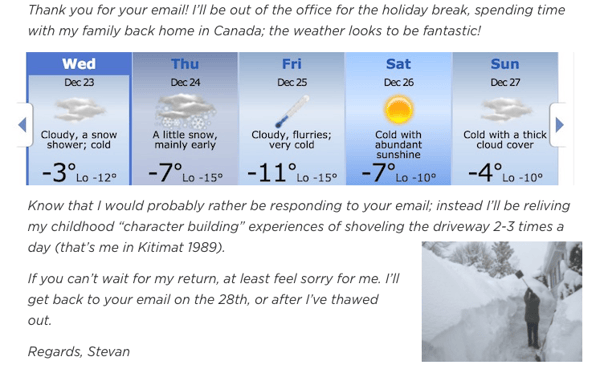
We'll give this guy first place, since we almost feel bad for him. Almost. Rather than using an out-of-office message for a tropical vacation, he used one to explain his absence during what would likely be a snowstorm. Not only did it give us a chuckle, but it also generated a certain amount of empathy -- which is often the key to good content.
Source: New Relic
2. The Sorry-I'm-Not-Sorry
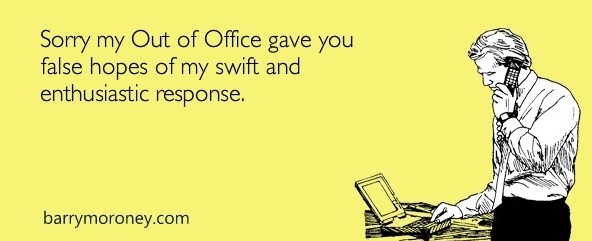
If your email client allows it, you could always just use an image to express your out-office-sentiment, like this one. After all, they say that a picture is worth a thousand words -- and, visual content is still essential to successful marketing.
Source: Barry Moroney
3. The Popular Film Reference
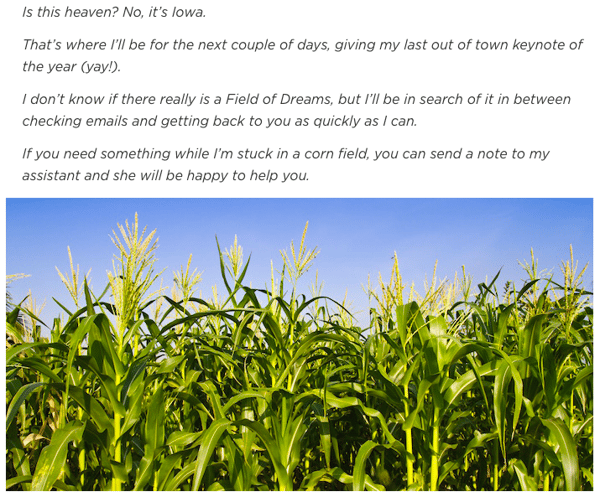
Are you familiar with the film Field of Dreams? If not, allow us to fill you in. It centers around baseball and a family in Iowa, but saying any more might spoil the plotline.
Movie synopses aside, the opening line of this out-of-office message was taken directly from the Field of Dreams script -- fitting, given the sender's travels to Iowa. So before you leave, research some famous quotes about the place you're visiting. It might test the recipient's knowledge, but more likely, it'll just make them smile.
Source: New Relic
4. The Scavenger Hunt
When my colleague Sam Mallikarjunan went on vacation, he set an out-of-office message that was both clever and smart. First, he sent the recipient on an imaginary scavenger hunt to "the highest peak of the tallest mountain." He used humorous absurdity to make it clear that he would not be checking email while he was away.
Plus, he incorporated a delightful technique to let people know that if they really wanted him to read their emails, they should probably send them again after his return. Not only does that keep the sender accountable by saying, "If this is really important, you know when to reach me," but it also helps Mallikarjunan truly vacate his work while he's away. And that's hard to do -- And if you struggle with it, check out these tips.

Source: Sam Mallikarjunan
5. The Blunt Approach
Josh Kopelman, we salute you.
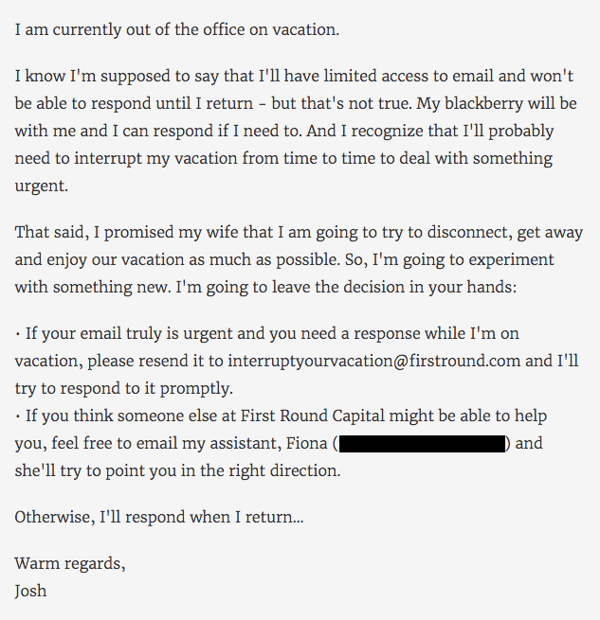
Not only did Kopelman manage to turn his out-of-office message into an epic poem of sorts, but also, he actually went through the trouble of creating a delightfully snarky, vacation-specific email address for his recipients.
Giving the option to contact an email address containing "interruptyourvacation" provides two things -- 1) A dose of humor, and 2) discouragement from actually doing what the name suggests. Plus, he prefaces it with a request for empathy, by explaining that he promised quality time to his family.
Here's where honesty is a helpful device. Sure, Kopelman is truthful about the fact that he's on vacation, but he also lets the recipient know that he or she would be interrupting important family time if the first option is chosen. It states a point simply, and uses humor to avoid making it sound like he wants the reader to feel guilty.
Source: Gizmodo
6. The Third Person
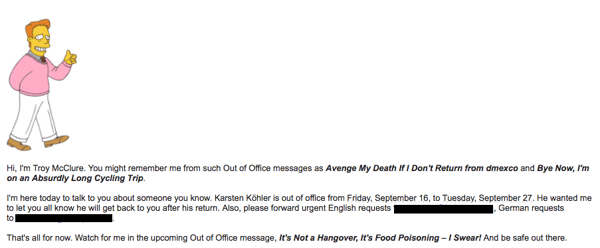
When HubSpot Marketing Manager Karsten Köhler is out of the office, he doesn't mess around. In fact, he's turned his auto-responses into a running series of commentary for fictional cartoon character Troy McClure.
Each time McClure makes an appearance in these out-of-office messages, he "speaks" on behalf of Köhler and alludes to the previous auto-responses in which he starred. It's a mild form of self-deprecating humor -- as if to say, "I know, I'm out of the office again" -- made only funnier by the made-up teaser title included in the last line.
As with the Field of Dreams example, don't be afraid to use a pop cultural reference that audience would recognize. Instead of bemoaning your absence, they'll have something fun and familiar to laugh at.
Source: Karsten Köhler
7. The Twitter Method
... and then, there was the out-of-office tweet. We're not entirely sure where it originated, but it has two sides.
If you actually want people to be able to reach you, and you're more likely to be checking Twitter than email while out of the office, it might be an effective way for people to reach you.
But if you tend to use social media during vacation and really do want to be left alone, we would suggest offering a different communication method in your auto-response.
I’m not in the office right now but if it’s important, tweet me using #YOUAREINTERRUPTINGMYVACATION pic.twitter.com/SgL97nof8L
— Philippe Khattou (@Phil_Khattou) August 14, 2015
8. The Liquid Update
We wish we could find the original source of this one. It's made several lists, and its author is likely a legend within his or her network.
That said, even though we've been preaching honesty as the best policy, be careful with messages that are this transparent. Make sure you're familiar enough with your audience -- and your boss, for that matter -- to know that this sort of out-of-office message will be met with a snicker, and not with concern.
I am currently out of the office and probably out-of-my-mind drunk. Enjoy your work week."
9. The Guessing Game
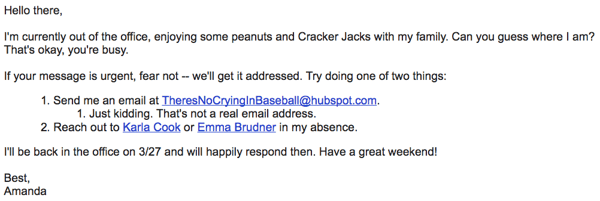
There's a term that we like to use around here called "snowbirds," which is used to describe those who once resided in the northern part of the U.S., only to flee to warmer parts of the country during the winter.
And although I had mixed feelings about my own parents joining that population in Florida, I couldn't be too upset when my dad suggested flying down from Boston for a Red Sox spring training game.
Naturally, I had to take the day off -- and couldn't let folks know with any old generic auto-response. Instead, I made a guessing game of it.
10. The Out-of-Office Mad Libs
If you're feeling a bit stumped for inspiration -- be it the eggnog or a full calendar of engagements to blame -- there's a template for that.
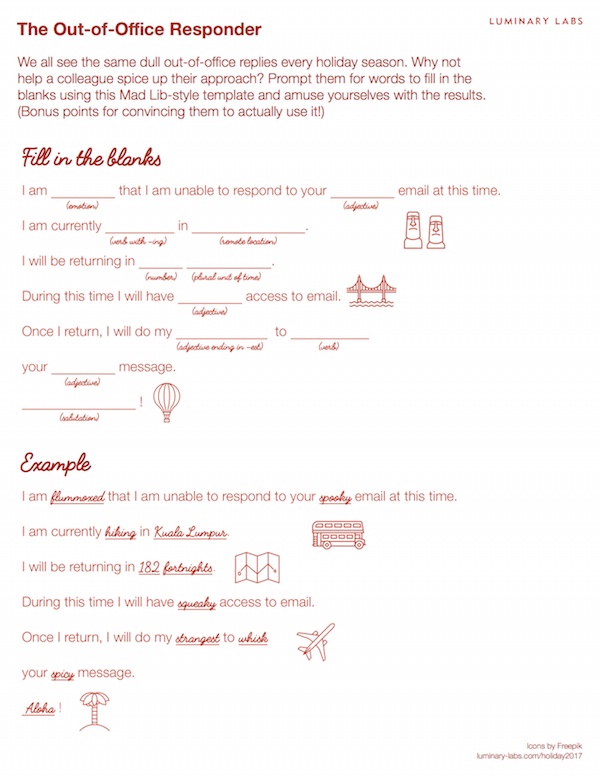
Luminary Labs, to the joy of those suffering from writer's block everywhere, came up with a Mad-Libs-style out-of-office message generator that lets you simply fill in a noun, verb, or adjective to describe why you're out of the office and when you'll be back.
Might we recommend it as a team-bonding activity for your company holiday party? Here's how one such exercise turned out:

Are Google's Featured Snippets Eating Your Blog Traffic?
The HubSpot Marketing Blog has been around since 2006.
Think about that for a moment. It's been 11 years -- with is plenty of time for successes, failures, changes, and growth. And within that tradition, the Marketing Blog has been no exception.
The Marketing Blog has been a key part of HubSpot’s inbound business. The more posts we published, the larger our audience grew. In 2014, we celebrated reaching 1.5 million views a month. And now, we take pride in our 4.5 million monthly visits.
But then, earlier this year, we noticed that our traffic was falling flat. Then, it declined. In such a short period of time, we had gone from impressive growth to stagnation -- and what's worse, we couldn't figure out why.
Sound familiar?
We have an answer -- but the news isn't exactly, well, good. As it turns out, Google is likely eating your blog traffic -- specifically, its featured snippets.
Here's how we found out.
What Is Google's Featured Snippet?
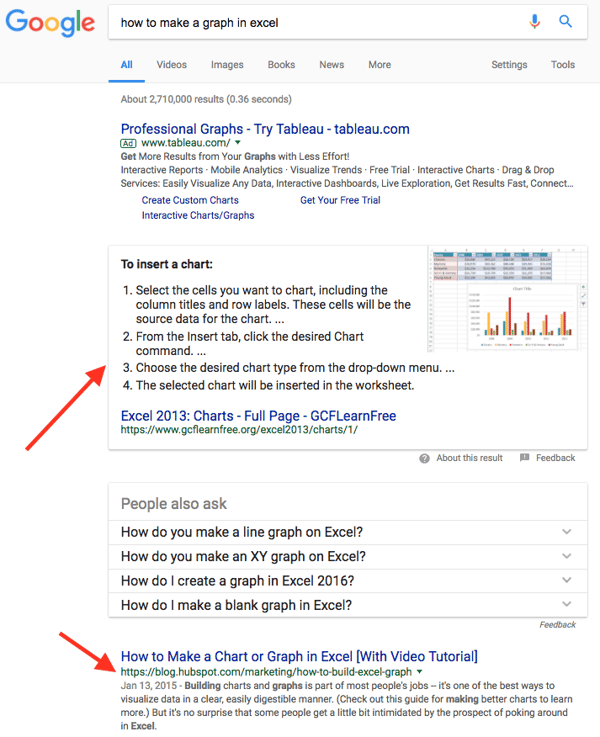
A featured snippet is a concise response to a Google search query. It's displayed on top of the general results, and also includes the page's publication date, title, and URL.
How We Discovered What Happened
While we spent several months trying to figure out what was going on with our traffic, for the purposes of this post, we'll be focusing on the data we collected that led to our discovery of featured snippets eating blog traffic. To read about the full methodology, visit our research report.
When we looked at the existing data available on this matter, we discovered that, at the root of the issue was that search is simply changing. The number of featured snippets on search engine results pages (SERPs) has grown 328% since summer 2015. On top of that, just under one-third of Google searches now returns a featured snippet.
That may not sound like a huge amount, but when you also consider that, according to Moz, almost half of today's searches result in zero clicks, it indicates that people might be getting the answers they need directly on the SERP -- no page visits required.
In other words, the trends indicated that we were likely losing traffic to featured snippets, whether that snippet received any clicks or not.
What That Means
To put that into context, consider that on SERPs with no featured snippet, we found that the first result can expect to bring in about 33% of the total clicks. The second result accounts for 18%, and the rest, 11% or under.
But we couldn't just take their word for it. We had a deeper look to see if this was, in fact, happening with our own blog posts, highlighting a few that particularly stood out to us.
With a featured snippet, position #1 is, well, a losing result. That's because the featured snippet gets such a high ratio of clicks -- about 50%, versus 33% -- decreasing clicks on the remaining results below it to the point that some of the top 10 become nearly obsolete.
So, yeah -- with featured snippets appearing on a third of all Google SERPs, there's a good chance that they're eating your traffic.
We suspected that might be the case with a few of our own blog posts, and picked out three examples for which our page rank on the SERP didn't fluctuate significantly year-over-year -- in fact, in some cases, it remained in position #1 -- but we didn't capture the featured snippet for the highest-volume queries or keywords.
Here's how much the raw traffic on those posts decreased.
1. "How to Make a Chart or Graph in Excel"
Query: "how to make a graph in excel"
Monthly search volume: over 8,000
How we appeared in the SERP: Position #1 -- but didn't capture the featured snippet
The result: 38% decrease in visits from 2016 to 2017
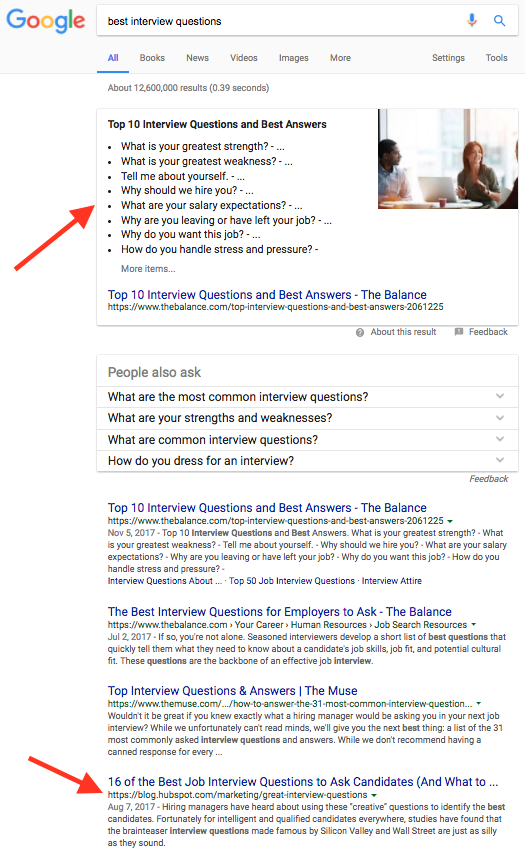
2. "16 of the Best Job Interview Questions to Ask Candidates"
Query: "best interview questions"
Monthly search volume: over 9,000
How we appeared in the SERP: Position #4 -- didn't capture the featured snippet
The result: 35% decrease in visits from 2016 to 2017
3. "15 Hidden Instagram Hacks and Features"
Query: "instagram hacks"
Monthly search volume: over 1,000
How we appeared in the SERP: Position #1 -- but didn't capture the featured snippet
The result: 24% decrease in visits from 2016 to 2017
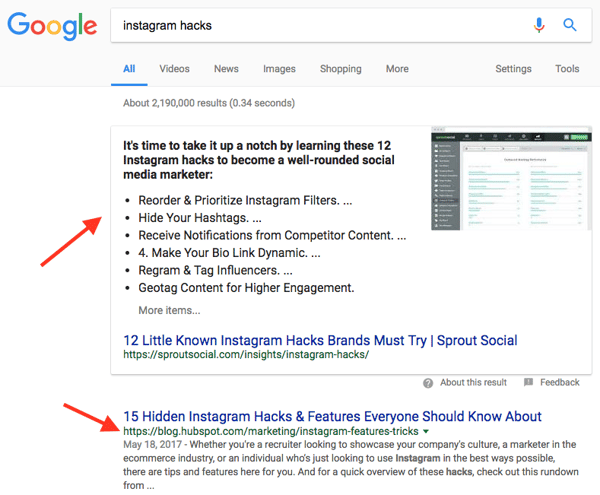
It boils down to the click-through-rate (CTR) from the SERP. Featured snippets were the primary reason we’ve seen our blog traffic flatten this year -- even though we ranked well, someone else accounted for half of the clicks, ultimately bringing down our raw traffic.
What to Do About the Featured Snippet
Moving forward, there are some things that can be done to fight these changes. Here are the two primary ones we're testing.
1. Capturing the featured snippet.
We're optimizing existing posts that are currently not capturing the featured snippet, and creating new posts with the featured snippet -- as well as other search features -- in mind.
2. Finding the green space.
Snippets are not going away -- and as long as they're around, they'll continue to eat blog traffic -- sometimes, despite your best efforts. So even with optimization, we won’t ever completely replenish the traffic we lost. To counter that, we’ll work to identify subject matter gaps that created content and clusters in new topic areas where our audience is seeking answers.
... for now, at least. What's your plan? Feel free to weigh in on Twitter, or let us know if you have a question about it.
